The short answer
Travel on a budget by spending deliberately, not minimally: decide which one or two experiences are the whole point of the trip and fund them fully, then cut hard on the things you will not remember — expensive neighborhoods, tourist-trap meals, paid versions of free experiences. A budget is a set of priorities, and the cheapest trip is rarely the best one.
Two friends took the same trip to Thailand on the same money and came home with different stories. Ravi spent his evenly — a decent hotel, decent meals, a bit of everything — and remembers it as “nice.” Elena spent hers lopsidedly: a cheap room she barely used, street food she adored, and one splurge, a diving trip she had wanted her whole life, funded in full. She remembers it as one of the best weeks of her life. Same budget. Wildly different trip.
That is the secret budget travel never puts on the poster: cheap and rich are not opposites. The traveler who spends deliberately — pouring money into what matters and cutting ruthlessly on what does not — eats better stories than the one who spreads the same money thin. Budgeting is not deprivation. It is editing.
Decide what the trip is actually for
Before you cut a single cost, name the one or two things that are the whole reason for the trip. The dive. The tasting menu. The concert. The single unforgettable day. These are non-negotiable, and you fund them completely. Everything else is negotiable in service of them.
A budget is not a limit on joy. It is a decision about where the joy goes.
This inversion is the whole game. Most people budget defensively — trim a little everywhere, apologize to themselves for every expense. Budget offensively instead: protect the highlights, and let everything else be as cheap as it wants to be.
Cut hard on what you won’t remember
Once the highlights are funded, the cuts stop hurting, because you are cutting things that were never the point:
- Where you sleep. On an active trip the room is a place you are unconscious. A clean, well-located cheap bed beats an expensive one you barely see.
- Location tax. The café on the main square charges triple for the view. Walk two streets; pay half; eat better.
- Paid versions of free things. Free walking tours, public viewpoints, city beaches, and museums with free days often beat their paid equivalents.
- Eating like a tourist. The best meals abroad are frequently the cheapest — markets, street food, the place full of locals with no English menu.
Know your numbers so you can spend freely
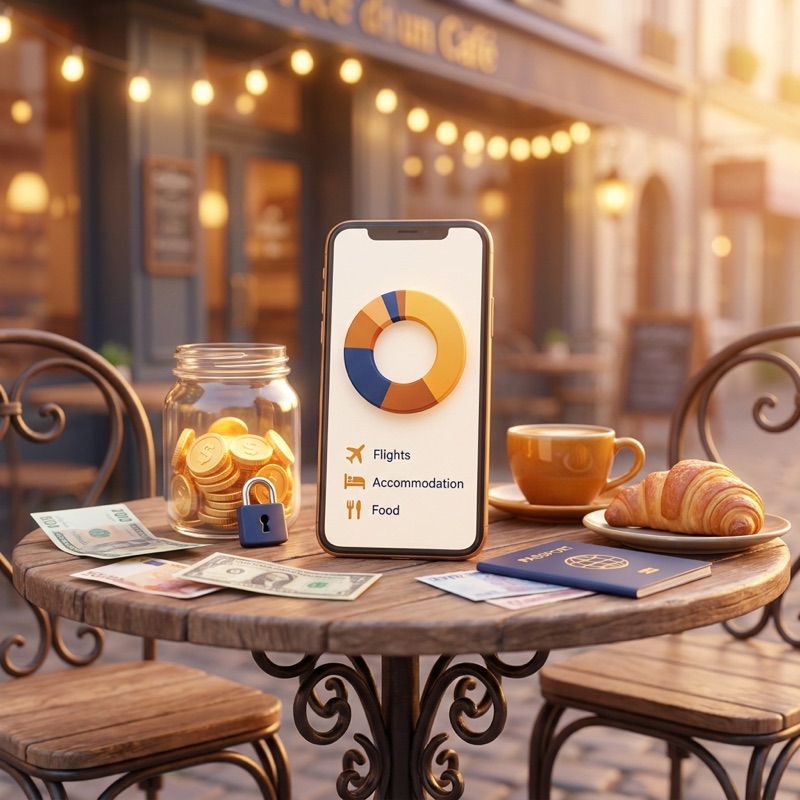
Here is the counterintuitive part: tracking your spending does not make travel stingy — it makes it relaxed. When you can see you are running under budget on food and lodging, you get to say yes to the splurge without guilt, because you know it fits. The travelers who feel anxious about money on the road are usually the ones flying blind. Visibility is what buys permission.
The trap, again, is the foreign-currency fog: small costs you cannot translate, quietly adding up until the budget you set is gone and the splurge you wanted feels reckless. Real-time tracking dissolves that fog and hands the decision back to you.
Spend on purpose
Budget travel done well is simply intentional travel — highlights funded, filler trimmed, and a clear view of the numbers so you can say yes to the right things.
TripOverall supports exactly this way of traveling: set a budget per trip, log expenses in seconds, and watch live charts show where your money is going by category — all converted at daily bank rates so nothing is a mystery. It even estimates realistic daily costs for your destination before you go, so you can plan the splurge in from the start. It is free on iPhone and Android — proof that the best-remembered trips are rarely the most expensive ones.